
Material Development 4.0
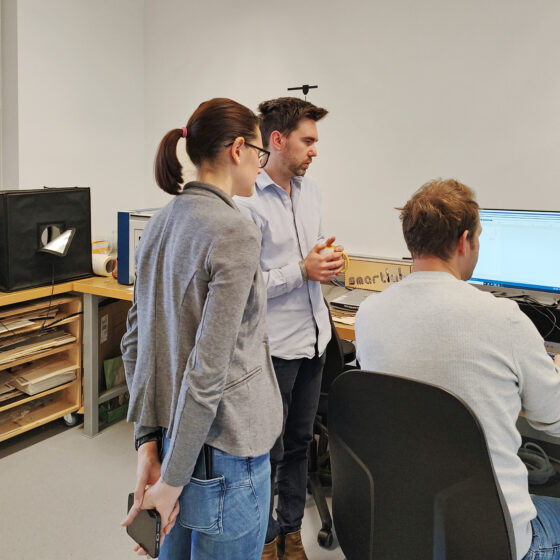
Digital and Technical Skills for Analog Teaching Materials | Material Development 4.0 Connects Schools and FabLabs: With the help of digital manufacturing technologies, teachers independently develop analog teaching materials—from the initial idea through the prototype to the finished product.
Project
As part of the BMBWF’s nationwide digi.case project, professional development programs for elementary school teachers were implemented throughout Austria starting in the 2023–24 school year. These professional development programs combined asynchronous online formats (MOOCs) with in-person training and addressed key future-oriented skills such as computational thinking, problem-solving skills, and digital competencies. A key feature of the program was the deliberate integration of digital resources with analog teaching materials.
A central element of these training sessions was the so-called «media kit,» which is not only designed as a collection of ready-to-use materials but is also explicitly intended to encourage participants to further develop, adapt, and independently create materials. Building on this approach, the present project takes it a step further and specifically expands it to include a technical and practical development perspective.
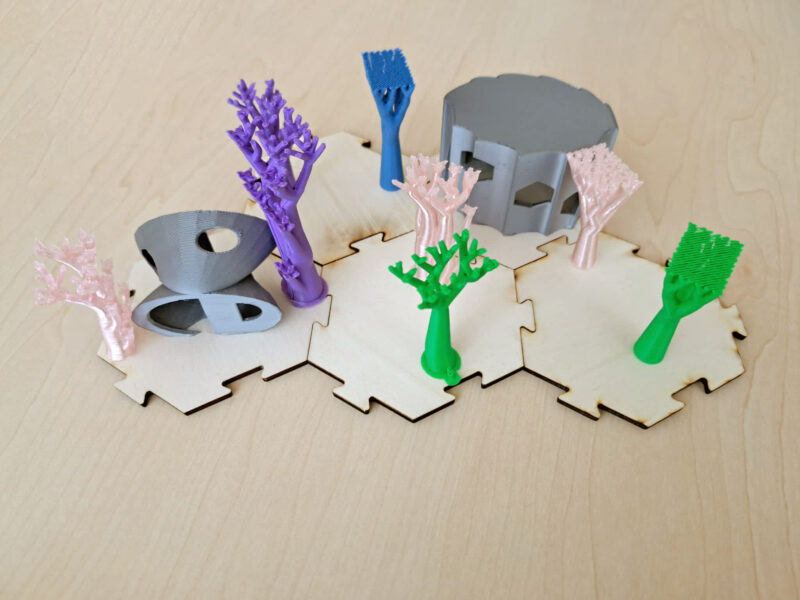
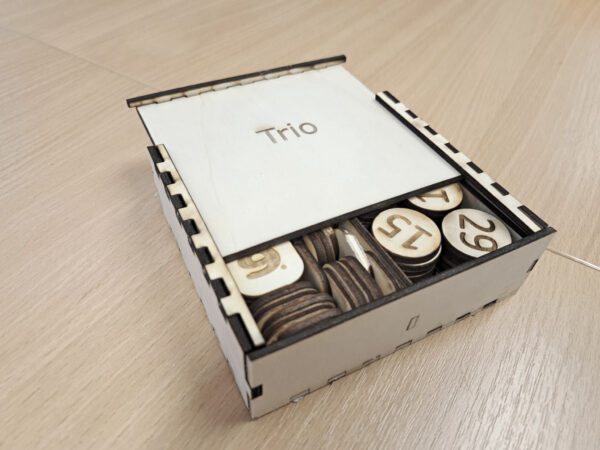
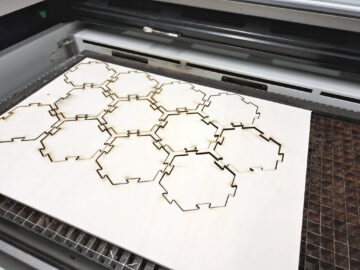
The goal is to use FabLab infrastructure to equip teachers with the digital and technical skills necessary to design and produce their own analog teaching materials that go beyond textbooks and worksheets. Building on existing materials (e.g., Soma cubes, Geoboard, tangrams), new material concepts are developed, prototyped, and adapted for practical use in the classroom.
For the 2024–25 school year, corresponding professional development courses for elementary school teachers are planned; these will be offered through the Carinthia University of Education as part of the Education Innovation Studio. In these training sessions, participants will design analog teaching materials tailored directly to the specific needs of their own classrooms. The technical implementation—for example, using 3D printing or other digital manufacturing technologies—will take place during guided hands-on sessions in the SmartLab.
Beyond the development of individual teaching materials, the project aims to build a sustainable community of educators who engage with topics such as analog and digital teaching materials, digitization, STEM education, and experimental work with technology, and who network with one another both professionally and collegially.
Organization & Info
Corinna Mößlacher, Nora Ulbing, and Harald Meyer
Carinthia University of Education
Hubertusstraße 1
9020 Klagenfurt am Wörthersee
Competency Model
Using the GECKO platform, the competency model outlines the skills that teachers can acquire as part of the project.

Downloads & Resources
All content as well as learning and teaching materials are licensed as Open Educational Resources (OER) under the Creative Commons license CC BY-NC-SA 4.0 and may only be shared or edited under the following three conditions: Attribution – Non-commercial – Redistribution under the same conditions.
Highlights
Funding Agency
The initiative was supported and facilitated as a project within the Educational Innovation Lab for Sustainable MINT (EIL4MINT) at the Educational Lab. EIL4MINT is funded by the Innovation Foundation for Education and implemented as part of the FFG program«Innovation Labs for Education.»
Co-funding organizations:
, Lakeside Science & Technology Park GmbH, University of Klagenfurt, Carinthia Department of Education, Carinthia University of Teacher Education, Carinthia University of Applied Sciences
