
The UN HumanRightsCouncil
A Conference Simulation
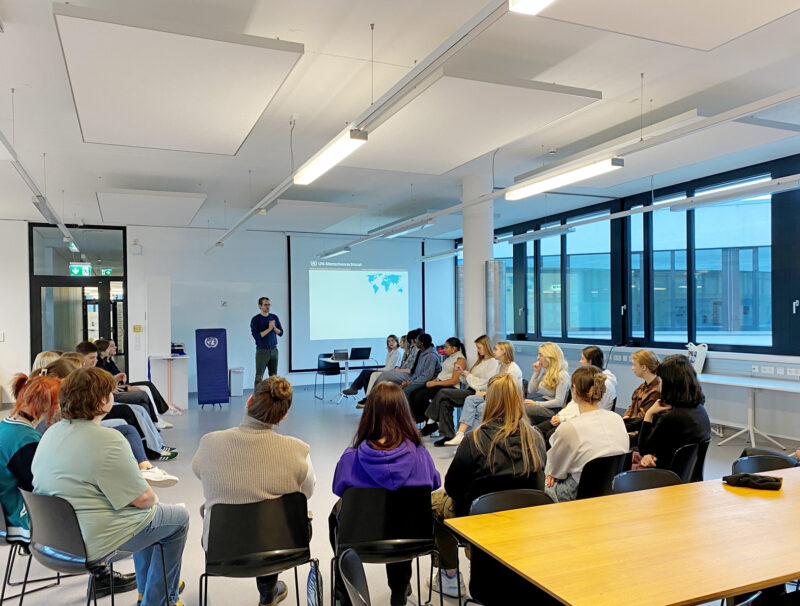
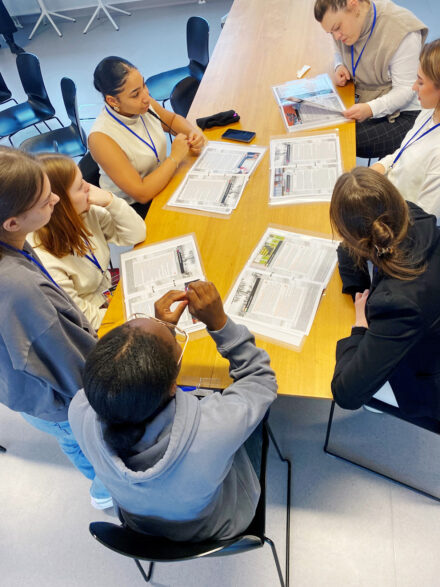
In this conference simulation, participants reenact the work of the UN Human Rights Council. They take on the roles of representative actors and engage in negotiations to discuss whether the death penalty is compatible with human rights, and then vote on resolutions. During the debriefing, participants reflect on what took place and compare it with real-world developments in the UN Human Rights Council.

Project
The project «The UN Human Rights Council—A Conference Simulation» allows students to role-play the work of the UN Human Rights Council through a conference simulation. High school students take on the roles of representatives from various countries and organizations to engage in discussions and negotiations on whether—and to what extent—the death penalty is compatible with human rights. The goal is to develop a deeper understanding of human rights issues, to understand how international organizations function, and to strengthen skills in democratic processes. This topic is also embedded in the Austrian curriculum: In upper secondary school (AHS and BHS), the curriculum for history, social studies, and political education explicitly calls for exploring fundamental and human rights, international organizations such as the United Nations, and current political and legal issues. The death penalty can be addressed as a controversial topic, for example through international comparisons or in the context of international treaties such as the European Convention on Human Rights. In lower secondary school (8th grade) as well, the topic of human rights is included in the curriculum for history and political education, with the aim of helping students learn about fundamental rights and their significance for society and daily life. This is precisely where the project comes in, by transforming the exploration of human rights issues—such as the death penalty—into an action-oriented format.
The project includes role-playing exercises, discussions, votes, and reflection periods. Materials include text documents that contain, for example, background information, details on the procedure, or draft resolutions. In addition, presentations and documents for the physical layout of the space are provided. The conference simulation spans six class periods. Since students will increasingly work in small groups, it is advisable to select an appropriate room for this activity. The simulation is conducted under the guidance of a facilitator who coordinates the proceedings. During the final evaluation, participants reflect on the results of the simulation.
Organization & Info
Tim Hübener
huebener@demokratiezentrum.org
Democracy Center Vienna
Hegelgasse 6/5
1010 Vienna
demokratiezentrum.org
Project Team
Competency Model
Using the GECKO platform, the competency model outlines the skills that teachers can acquire as part of the project.
Downloads & Resources
All content, as well as learning and teaching materials, are licensed as Open Educational Resources (OER) under the Creative Commons CC BY-NC-SA 4.0 license and may only be shared or modified under the following three conditions: Attribution – Non-Commercial – Share Alike.
Highlights
Funding Agency
The initiative was supported and facilitated as a project within the Educational Innovation Lab for Sustainable MINT (EIL4MINT) at the Educational Lab. EIL4MINT is funded by the Innovation Foundation for Education and implemented as part of the FFG program«Innovation Labs for Education.»
Co-funding organizations:
, Lakeside Science & Technology Park GmbH, University of Klagenfurt, Carinthia Department of Education, Carinthia University of Teacher Education, Carinthia University of Applied Sciences
